End-to-End Hardware & Software Synergy for Passive Optical Networks
From clip-on passive tags to cloud OSS integration, every layer is engineered for carrier-grade field operations.
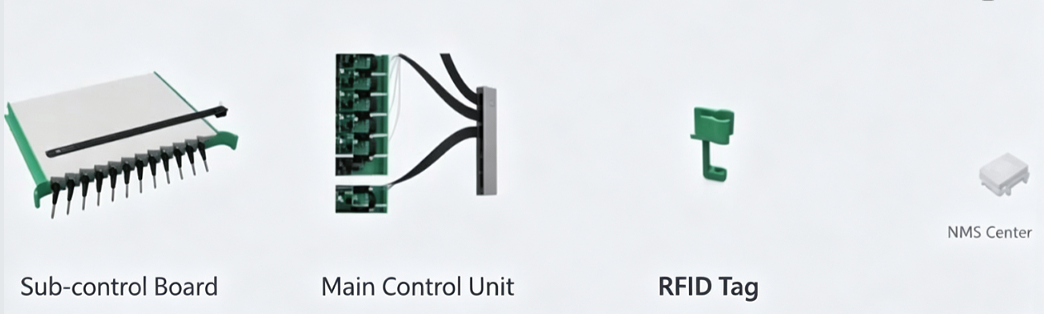
Sub-control Board
(Standard ODF/Sub-rack Compatible)Modular optical tray/sub-rack controller for real-time port state monitoring.
Main Control Unit (MCU)
High-reliability central controller for data aggregation and bus communication.
RFID Tag
(No external power required)Clip-on passive smart tags for optical patch cords and fiber ports.
Central NMS / Cloud OSS Platform
Centralized Optical Resource Management System with cloud OSS integration engine.
Standards & References
The hardware stack follows standard 19-inch and ETSI EN 300 119 rack ODF sub-rack structures, and the platform layer aligns with ITU-T G-PON series recommendations and TM Forum Open Digital Architecture, so it retrofits into existing frames and OSS estates without rewiring the patch field.
Plug-and-Play Passive RFID Retrofit Kit
Watch how the retrofit kit overlays RFID intelligence onto existing ODF frames and street cabinets: no rewiring, no service interruption, no external power on tags.
Overlay, Not Replace
Clip-on passive tags and sub-rack controllers retrofit onto live frames without touching existing jumpers.
Zero Downtime Install
Cabinets stay in service during installation; scanning validates every port as the kit is fitted.
Instant Platform Sync
Collected tag data uploads to the central NMS / cloud OSS platform and closes the task on site.
Lightweight Mobile App Operations + Fiber Path Digital Twin
Mobile efficiency for field teams. Visual intelligence for fiber resources. A smarter way to manage your network.
Lightweight Mobile Field Operations
- One smartphone completes site connection, tag collection, and task closure.
- Streamlines on-site construction, routine inspection, and preventive maintenance.
- Eliminates paper-based records and redundant manual data entry.
- Frontline staff can operate with zero learning curve.
Fiber Path Digital Twin
- Maps physical fiber connection relationships into a dynamic, visual topology model.
- Supports end-to-end path tracing, port occupancy lookup, and real-time relationship verification.
- Full-path physical traceability for every fiber link.
- Pinpoints fault locations accurately to accelerate MTTR (Mean Time to Repair).
On-site work becomes easier, resource topology becomes crystal clear, and fault handling becomes significantly more efficient.
Enhance Operational Efficiency Through Digitalization
Reduce operational complexity · shorten construction time · lower labor costs · increase asset utilization.
From Manual Lookup to Sub-Second Calculation
Platform intelligence makes physical assets transparent and accelerates network planning and maintenance.
End-to-End Resource Visualization
Full visibility of nodes, ODF ports and fiber cores; real-time topology displays complete end-to-end physical routing.
Intelligent Service Route Computation
Core algorithmic routing automatically designs optimal end-to-end paths and outputs work orders in seconds.
Rapid Fault Restoration & Failover
Pinpoint breaks and switch to standby protection routes within 1 second, drastically shortening critical network downtime.
Frequently Asked Questions
Answers to the questions carrier engineering teams ask us most.
Does the RFID retrofit kit work with existing ODF frames and sub-racks?+
Yes. The sub-control board follows standard 19-inch and ETSI EN 300 119 rack structures, so it retrofits into existing ODF frames and sub-racks without rewiring the patch field. Passive clip-on RFID tags require no external power and no changes to the fiber itself.
How is port and fiber data collected in the field?+
A single smartphone runs the lightweight mobile app: it connects to the site controller, auto-scans RFID tags on ports and patch cords, and closes the task on the spot. Field-measured audits dropped from 172 minutes to 30 minutes, and information entry from 112 minutes to 5 seconds.
Can the platform integrate with our existing OSS / NMS?+
The central NMS / cloud OSS platform provides an integration engine aligned with TM Forum Open Digital Architecture, so topology, port occupancy and fault data can be consumed by carrier OSS estates instead of living in a separate silo.
What happens when a fiber fault occurs?+
The fiber path digital twin pinpoints the physical fault location on the end-to-end topology, and the platform computes standby protection routes in under one second, drastically shortening MTTR compared with manual lookup.